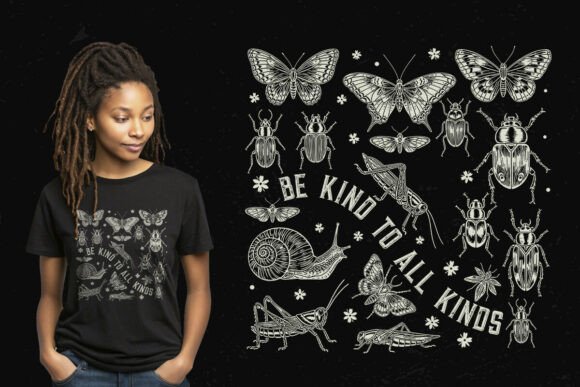
Be Kind to All Kinds Insect Lover Shirt
First Glance: A Design That Speaks Softly and Sells Kindness
When I opened the folder for the Be Kind to All Kinds Insect Lover Shirt bundle, the mood hit me before I even looked at the individual elements. This isn't a loud, in-your-face bug graphic. It leans into gentle linework, approachable little insect silhouettes, and a message that feels less like a slogan and more like a quiet invitation. Right away, I pictured this on naturally dyed tote bags, soft cream sweatshirts, and nursery pillows—the kind of products where the sentiment does as much work as the artwork itself.
As an embroidery designer, my first question is always: Will this truly translate to thread and fabric, or does it only live comfortably on a screen? The supplied PNG at 300 DPI and 4500–5400 pixels is crisp. But what really caught my eye were the SVG and EPS files tucked into the package. For anyone who digitizes their own embroidery designs, a clean vector file like this is a genuine time-saver. The shapes separate easily, the text is legible, and the insects—while small—hold their own without looking messy. There’s a gentle whimsy here that would make a finished embroidered product feel thoughtful, not childish.
It’s worth saying: the name Be Kind to All Kinds Insect Lover Shirt is specific, but the visual itself is versatile. The phrase “Be Kind to All Kinds” is broad enough to appeal to nature lovers, parents, teachers, and anyone who leans toward inclusive, feel-good messaging. The insects—simple bees, butterflies, and beetles—read as universal rather than hyper-realistic. This matters when you’re planning an embroidery project that needs to connect with a wide audience at a craft fair or in an Etsy shop.
Where This Insect Art Really Shines in Embroidery Projects
I’ve learned over the years that certain design styles practically stitch themselves, and this one has that quality. The Be Kind to All Kinds lettering is what I’d call “modified block with a soft edge.” It’s thick enough to take a satin stitch without collapsing into a thread blob, and the letters don’t have razor-thin serifs that get lost under a needle. The insects are the wild card, but here’s the good part: they’re designed as compact, rounded motifs. This means a skilled digitizer can map them efficiently with a mix of satin for outlines and light fill stitches for wings or bodies.
I ran my own mental test on how this would behave on a few common embroidery blanks:
- Unstructured canvas tote bags: The solid, blocky text and simple bug shapes would read clearly from across a room. Thread pull wouldn’t distort the letters, and the design wouldn’t rely on tons of fine detail that gets lost on textured cotton.
- Mid-weight sweatshirts: This is where the “kindness” tone matches the fabric perfectly. The design would sit beautifully on a dusty rose or heather oatmeal crewneck—something you’d list in a boutique gift collection.
- Baby and toddler apparel: The insect theme works here exceptionally well, but I’d scale the design down carefully. Keep the insects, maybe drop the smallest specks, and stitch on stable woven cotton. Parents love this message, and the insects are sweet without being scary.
- Kitchen towels and pillow covers: Both of these are low-stretch, flat surfaces that handle text and small motifs like this with ease. A natural linen pillow with “Be Kind to All Kinds” in dark olive thread instantly becomes a gift shoppers pick up and hug.
The included 2 premium mockups in the Graphics category are a nice touch for digital product sellers and Etsy shop owners who need quick, polished listings. But as an embroiderer, I’d use those PNG files differently: I’d print one version on cardstock, pin it to a finished product photo, and show customers exactly what the embroidered version will look like. That builds trust faster than a plain flat listing.
When Detail Becomes a Stitch Problem
No embroidery design is perfect straight out of a graphics folder, and the Be Kind to All Kinds Insect Lover Shirt artwork does have a few spots that need a designer’s careful eye before you load the hoop. The insects, while charming, contain very fine antennae and tiny leg details. On a 4x4 inch hoop, some of those lines will fall under 1mm. At that scale, a satin stitch turns into a single-thread mess, and running stitches are too faint to register. If you’re digitizing this yourself, my advice is to simplify the smallest critters—perhaps leave only two or three insects, enlarge them slightly, and keep the outlines clean.
Here’s a short list of situations where I’d pause and test more rigorously:
- Tiny hoop sizes (under 100x100mm): The text alone might barely fit. Trying to cram the whole layout in will ruin readability.
- Stretchy jersey t-shirts: Without a heavy cutaway stabilizer, the lettering will warp after one wash. The insects will pucker. I’d reserve this design for stable knits or wovens unless you’re confident with your hooping and backing choices.
- Dark fabrics with low-contrast thread: The mood of this design relies on being seen. If you stitch pale blue thread on navy fabric, those delicate insects vanish. Always test thread color on the exact fabric you plan to sell.
- Curved caps: The layout is too horizontal and wide for a traditional cap front. I’d move the text arc to fit, or use the design on flat cap side panels instead.
- Items that need aggressive, frequent washing: Think kitchen aprons that get bleached. The fine details won’t survive long-term. Reserve this for decorative gifts or low-wear home goods.
Putting It on Fabric: A Real Small Shop Scenario
Last month, I helped a friend prep for a spring market. She wanted a cohesive line of “kindness” products—tote bags, linen pouches, and kids’ tees. When the Be Kind to All Kinds Insect Lover Shirt concept landed in my inbox, it felt like a perfect fit for her aesthetic. We used the PNG file to print a mockup on cotton and pinned it to a tote bag to see how the scale breathed. Immediately, we knew two things: this design sells best when the insects look intentionally imperfect, and the lettering needs to be the anchor.
We digitized a version with a 5x7 hoop, keeping three core insects and thickening the text stroke by 0.3mm. The test stitch on unbleached cotton canvas was one of those moments where you just smile. The satin-stitched letters held a soft sheen, and the little bee wings had just enough open space to feel airy. We didn’t even use all the insect shapes from the original; some were simply too delicate. That’s the reality of working with a Graphics file for machine embroidery—you adapt, you simplify, and you never assume a flat design will magically stitch perfectly without human judgment.
I’ve seen similar designs on Etsy where sellers offer the phrase with a single embroidered butterfly or beetle, and customers respond with five-star reviews that mention “gentle,” “whimsical,” and “perfect gift.” That tells me the Be Kind to All Kinds concept isn’t just a fad—it’s a message people want to wear and display. As a craft business owner, tying your products to an emotional value like kindness often translates into repeat buyers and word-of-mouth referrals.
Why Sentiment Often Outweighs Complexity in Buyer Decisions
When you’re staring at an embroidery file or a digitized design, it’s easy to obsess over stitch counts and thread changes. But the customer sees something else entirely. They see a phrase that makes them feel good, and insects that remind them of a garden, a child, a shared moment. The Be Kind to All Kinds Insect Lover Shirt visual has that quiet pull. It’s not trendy or flashy—it’s consistently giftable. I’d happily use it on a personalized gift like a nursing pillow for a new parent, a set of embroidered patches for a teacher appreciation basket, or a custom sweatshirt for a nature club.
In embroidery, trust builds when your finished product matches the emotional promise of the design. If someone buys a “be kind” tea towel, they expect the stitches to feel soft, not prickly. They want the insects to look deliberate, not like a glitch in the machine. That’s why I always advocate for a test stitch on scrap fabric first—even if you’ve used the perfect SVG file. Thread color contrast matters. A pale yellow bee on an off-white background might need an outline that the original artwork didn’t include. Those small adjustments come from treating every design as a starting point, not a finished product.
From a commercial embroidery perspective, the bundle’s EPS and high-res PNG give you flexibility. You can easily create a clean black-and-white version for a stitch preview, show the design on a dark mockup to check contrast, or break it apart for an appliqué interpretation. I’ve also used similar digital files to create printable mockup sheets that I share with wholesale clients before committing to a large order. That transparency reduces returns and builds professional rapport.
Designer Notes That Save Time and Fabric
Before you finalize any embroidery project using the Be Kind to All Kinds Insect Lover Shirt art, I’d walk through this checklist. These aren’t theoretical—they’re hard lessons learned from years of running a small embroidery business:
- Verify your hoop size against the scaled design. The full layout with text and multiple insects needs at least a 5x7 hoop. For 4x4, drop down to just “Be Kind to All Kinds” or a single larger insect.
- Print the design at actual size and place it on the garment. Does the arc of the text follow the neckline or the pocket? Adjust before digitizing.
- Test thread colors with and without an underlay. Light insects on light fabric can look invisible. A thin dark outline or a contrasting underlay can rescue a pale palette.
- Evaluate the PNG file’s mockups in real product listings. Even if you sell only finished embroidered items, those premium mockups let you stage lifestyle photos that convert browsers into buyers.
- Check commercial licensing carefully. While the file bundle includes versatile assets, always confirm that the license covers embroidery digitization and resale of finished physical products. If you plan to sell digital embroidery files derived from the artwork, that’s often a different permission tier.
- Always stitch a sample on the exact fabric-and-stabilizer combo. What looks crisp on a woven canvas tote may distort on a soft French terry hoodie.
- Consider how the design looks after a wash cycle. I steam, wash, and dry my test pieces. If the insect legs disappear or the letters distort, I’m not ready to sell.
Final Take for the Craft Entrepreneur
If you’re an embroidery designer, a boutique maker, or an Etsy seller building a product line around nature, inclusivity, or gentle activism, the Be Kind to All Kinds Insect Lover Shirt artwork is a resource I’d absolutely keep on hand. The design itself is emotionally resonant, visually clean enough to digitize without a headache, and flexible across a range of embroidered products. The real value lies in the combination of a layered message, quality PNG files for mockups, and vector formats that save hours of redrawing. Just remember to treat every element as editable. Simplify the insects for smaller runs, adjust thread density for fabric type, and never skip the test stitch.
This isn’t a design that shouts. It’s the kind that rests quietly on a pillow or a tote and makes someone pause. In a market full of loud graphics and fast trends, a little kindness stitched in thread can be your best-selling edge.